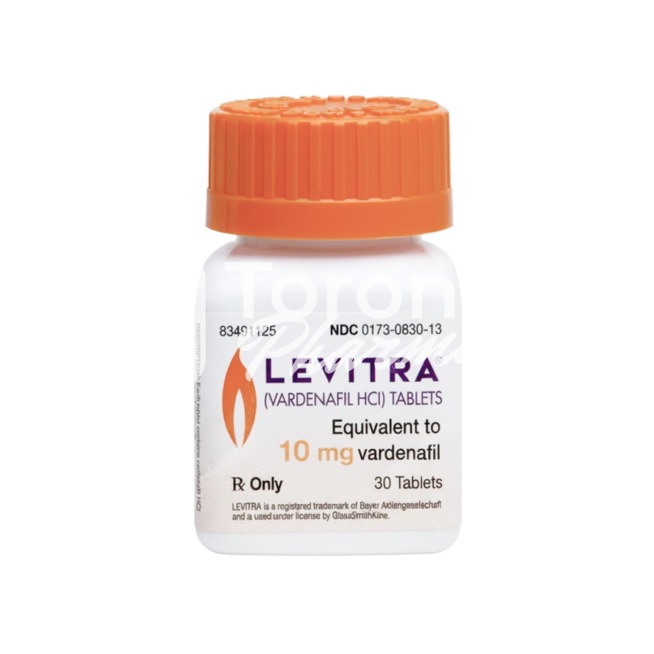
Levitra
In brief
Levitra – vardenafil treats erectile dysfunction by helping blood reach the penis more easily. Sexual stimulation is still needed for it to work.
Basic Levitra Information
- Active ingredient (INN): vardenafil (as vardenafil hydrochloride)
- Form: film-coated tablets for oral use
- Strengths offered: 10 mg and 20 mg
- Pack sizes offered: 10, 20, 30, 60, 90, 120, 180, 270 and 360 pills
- Drug group: phosphodiesterase type 5 (PDE5) inhibitor
- Prescription medicine: yes
What Is Levitra?
Levitra is a prescription tablet containing vardenafil, a PDE5 inhibitor taken by adult men who have erectile dysfunction. The information below follows the Health Canada product monograph for vardenafil. It is general guidance only, and your doctor decides whether Levitra is appropriate and at which strength.
What Levitra Is Used For
Levitra is used to treat erectile dysfunction, which is the repeated inability to reach or keep an erection suitable for sexual activity. It acts only when there is sexual stimulation, it does not raise sexual desire, and it is not intended for women or for men under 18.
How Levitra Works
Nitric oxide released during sexual stimulation raises cyclic GMP in the penile tissue and relaxes smooth muscle, allowing blood to flow in. PDE5 breaks cyclic GMP down. Levitra inhibits PDE5, which extends the natural response. Vardenafil is absorbed within roughly 30 to 120 minutes and acts for about 4 to 5 hours.
Levitra Strengths and Pack Sizes Offered
We offer Levitra as vardenafil 10 mg and 20 mg tablets. Pack sizes are 10, 20, 30, 60, 90, 120, 180, 270 and 360 pills. The 5 mg strength used in the monograph for older men is not part of this offer, so your doctor can tell you whether 10 mg or 20 mg tablets can be used in your case.
Levitra Dosage and Administration
Usual Levitra dose
The monograph describes a recommended starting dose of 10 mg about 60 minutes before sexual activity. The doctor may reduce it or raise it to a maximum of 20 mg depending on tolerance. Levitra should be taken no more than once a day and may be taken with or without food, although a high-fat meal can delay the effect.
Levitra in older men and in liver or kidney disease
Men aged 65 and over, and men with moderate liver impairment, are usually started on a lower dose than 10 mg. Levitra is not recommended in severe liver impairment or in patients on kidney dialysis.
Levitra with alpha-blockers and CYP3A4 inhibitors
When Levitra is combined with an alpha-blocker, the patient should be stable on the alpha-blocker first, and the doctor may use a lower dose. Levitra must not be combined with ketoconazole, itraconazole, cobicistat or HIV protease inhibitors such as ritonavir, indinavir, saquinavir or atazanavir. Other interacting medicines may require dose limits.
Who Should Not Take Levitra
- You use nitrates in any form, including recreational amyl nitrite.
- You take riociguat or another guanylate cyclase stimulator.
- You are allergic to vardenafil or any ingredient of the tablet, or have previously had non-arteritic anterior ischemic optic neuropathy (NAION).
- Sexual activity is inadvisable because of your cardiovascular status.
- You have congenital long QT syndrome, or you take class IA (quinidine, procainamide) or class III (amiodarone, sotalol) antiarrhythmic medicines.
- You take strong CYP3A4 inhibitors such as ritonavir or indinavir.
- You have severe liver impairment, very low blood pressure, recent stroke or heart attack, or a hereditary retinal disease.
Vardenafil can slightly prolong the QT interval on an ECG, so tell your doctor about any heart rhythm disorder before using Levitra.
Levitra Side Effects
Common Levitra side effects
Headache, flushing, nasal congestion, indigestion and dizziness are the most commonly reported. Some men also notice back pain, muscle aches or nausea.
Serious Levitra side effects
- Erection lasting more than 4 hours (priapism), which needs urgent treatment.
- Sudden vision loss in one eye (possible NAION).
- Sudden hearing loss, with or without ringing in the ears or vertigo.
- Chest pain, fainting, palpitations or an irregular heartbeat.
- Serious allergic reaction.
Stop Levitra and get medical help at once if you notice any of these. Frequencies are listed in the monograph.
Levitra Interactions
- Nitrates and riociguat: contraindicated.
- Alpha-blockers: additive blood pressure lowering.
- Ritonavir, indinavir, ketoconazole and itraconazole must not be combined with Levitra. Erythromycin and clarithromycin also increase vardenafil levels and require specific dose limits.
- Antiarrhythmic medicines: raise the risk of rhythm problems.
- Other treatments for erectile dysfunction: not to be combined with Levitra.
- Grapefruit juice may increase vardenafil levels.
Levitra, Pregnancy, Alcohol and Driving
Levitra is not for women and has no place in pregnancy or breastfeeding. Alcohol with Levitra can increase dizziness and reduce blood pressure, and large amounts may impair erections. Levitra can cause dizziness and changes in vision, so do not drive or use machinery until you know how you react.
Storing Levitra
Keep Levitra at room temperature (15 to 30 degrees Celsius) in its original packaging, away from damp and light, and out of children's reach. Do not use it after the expiry date.
Levitra Compared With Other ED Medicines
| Feature | Vardenafil (Levitra) | Sildenafil | Tadalafil |
|---|---|---|---|
| Usual starting dose | 10 mg | 50 mg | 10 mg as needed, or 2.5 to 5 mg daily |
| Maximum single dose | 20 mg | 100 mg | 20 mg |
| Approximate duration | 4 to 5 hours | 4 to 5 hours | Up to 36 hours |
| Heart rhythm caution | Yes (QT prolongation) | Less pronounced | Less pronounced |
Levitra FAQ
When should I take Levitra?
About 60 minutes before sexual activity, according to the monograph.
Can I take Levitra twice in one day?
No. Levitra should be taken no more than once per day.
Is Levitra safe with heart medicines?
It depends on the medicine. Nitrates and some antiarrhythmics must not be combined with Levitra, so ask your doctor to review everything you take.
Is Levitra a prescription medicine?
Yes. Levitra is only used under a doctor's supervision.